Bastionchip silicon in evaluation — now accepting qualified partner requests. Request Eval Kit →
Hardware Security Silicon

Root of trust.
Built into silicon.

Bastionchip designs hardware security modules and confidential-compute silicon for cloud infrastructure, financial services, and defense OEM platforms. Trust starts at the die.

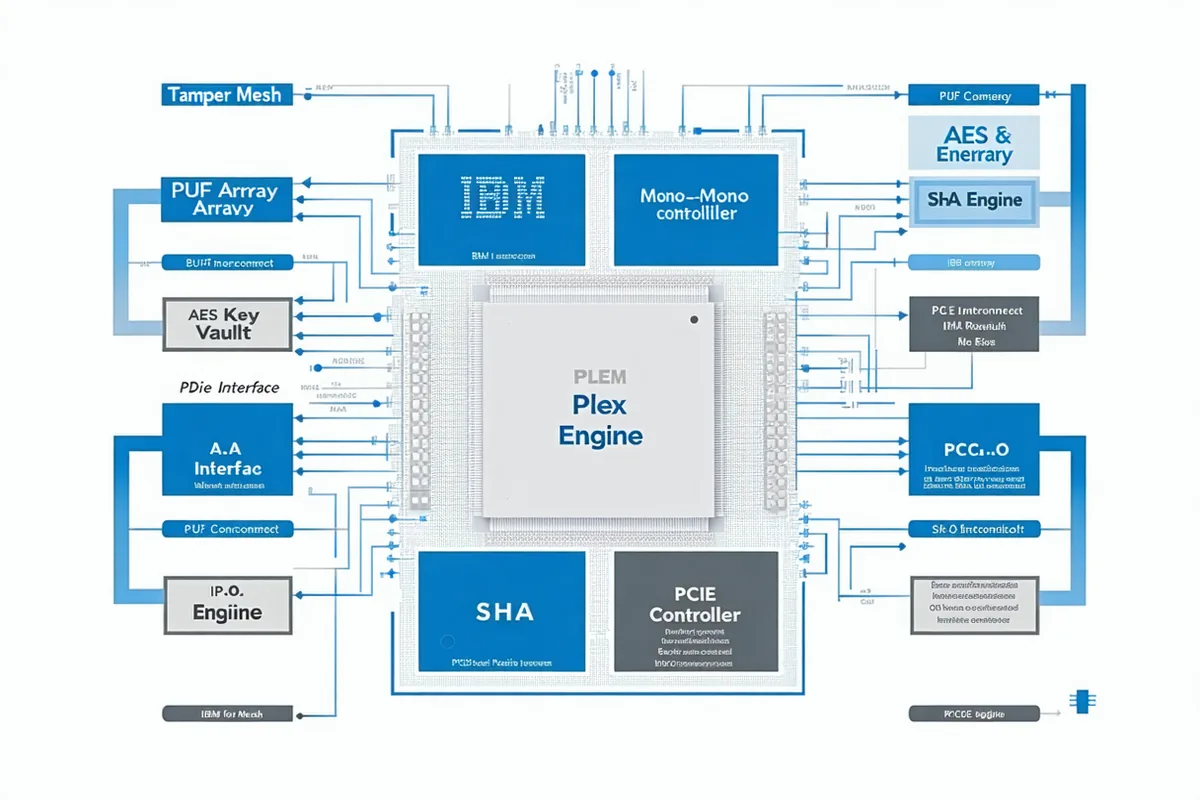
CRYPTO ENGINE AES-256 · SHA-3 ECC P-384 · Kyber-768 TAMPER MESH Active · Zeroize KEY VAULT 256-bit root · No ext bus PUF ARRAY Device Identity · Entropy INTERFACE CTRL PCIe x4 · SPI · I2C SECURE BOOT ROM · Attestation Chain-of-Trust PUF ZOOM Entropy cell
FIPS 140-3 Level 3 Target
10 Gbps Crypto Throughput
ECC + PQC Kyber-768 Support
<5 μW Standby Power
The Platform

Three silicon layers, one root of trust

HSM Silicon

Discrete security IC with dedicated AES-256-GCM hardware pipeline, active tamper-detection mesh wired to zeroize logic, and 128 hardware-protected key slots that never appear on any external bus. PCIe x4 and SPI host attachment. FIPS 140-3 Level 3 target.

HSM specifications

Confidential Compute

TEE-enabling silicon IP block for SoC integration. Enclave memory encrypted in silicon, per-enclave key management in hardware, signed attestation tokens anchored to PUF device identity. Isolation holds under hypervisor compromise — not a software boundary.

Architecture details

Secure Boot & Attestation

Six-stage boot chain from immutable silicon ROM to running OS, with PCR extension at each stage. Remote attestation token binds the full measurement chain to PUF device identity — no factory key injection, no software trust required on the host.

Boot chain details
Use Cases

Designed for environments where key compromise is existential

Cloud Infrastructure

Hardware-attested confidential VMs and TEE-backed key management for hyperscale and sovereign cloud deployments. Keys stay in silicon on each host — no network HSM latency, no hypervisor trust boundary.

Cloud infrastructure details

Financial Services

Silicon-native key custody designed for FIPS 140-3 Level 3 and PCI-HSM requirements. Core banking master key storage, PIN block encryption, and digital asset custody — without the centralized failure surface of network HSM appliances.

Financial services details

Defense & OEM

ITAR-aware design process, sub-nanosecond zeroize response, and post-quantum crypto agility for long-lifecycle embedded platforms. Industrial temperature grade. NDA-first evaluation for sensitive programs.

Defense & OEM details
Silicon Architecture

Tamper-mesh. PUF entropy. Hardware key isolation.

Every Bastionchip die ships with an active tamper-detection mesh wired to zeroize logic. Physical Unclonable Functions seed a 256-bit device root key that never traverses external buses. The crypto engine handles AES, SHA-3, and ECDSA operations in hardware — no firmware-accessible key registers.

View Architecture
Bastionchip silicon block diagram showing tamper mesh overlay, PUF cell array, crypto engine, key vault, and PCIe interface controller with labeled interconnects
Engineering Notes

Technical depth from the team building it

View All Posts
Microscopic view of silicon PUF cell array structures on a chip die
PUF

Why Physical Unclonable Functions Beat Factory Key Injection

An examination of PUF entropy sources in custom silicon and why they eliminate the factory provisioning attack surface entirely.

Read post
Abstract visualization of an active tamper detection mesh pattern overlaid on a chip die
Tamper Detection

Active Tamper-Mesh Architecture for Custom Security ICs

Design considerations for active metal tamper meshes: material choice, mesh density, response time, and false-positive rate management.

Read post
Abstract visualization of cryptographic algorithm migration and post-quantum lattice structures
Post-Quantum

Crypto Agility in Hardware: Preparing for Post-Quantum Migration

How to design silicon that supports algorithm migration — and why Kyber-768 in hardware is only half the story.

Read post

Evaluation silicon is available — for the right programs.

We work with a small number of design partners at a time: cloud KMS teams, payment processor security architects, and defense OEM integrators. If your key custody architecture needs hardware-rooted trust that a network appliance or software KMS cannot provide, let's talk.